What reliable should mean for LLMs in life sciences
In scientific and regulated settings, reliability is less about polished prose and more about whether claims remain traceable to evidence, scope, and method.
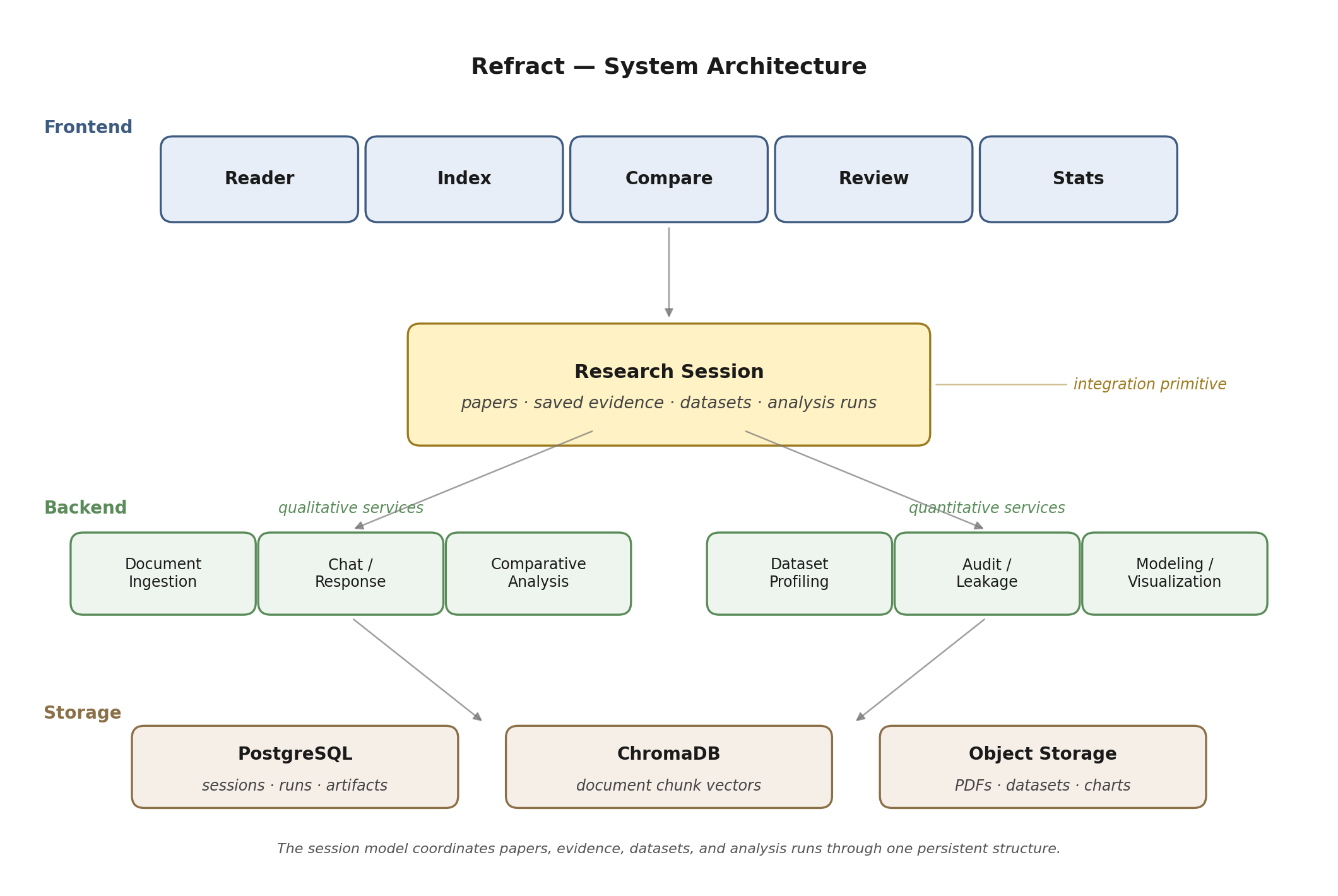
Reliability in life sciences is a systems property, not a tone of voice
A response does not become reliable because it sounds careful. It becomes more reliable when the surrounding system constrains what can be claimed, preserves the evidence in scope, and makes later checking possible.
That is why the discussion has to move away from stylistic fluency and toward architecture, provenance, and evaluation.
Reliability is not a style attribute
The hardest failure is not awkward wording. It is unsupported confidence.
In life sciences and other regulated domains, a response does not become reliable because it sounds measured or technically literate. Reliability has to be earned through constraint: bounded claims, visible evidence, and language that remains proportionate to what the source material actually supports.
This shifts the design problem. The question is not only how to make a model answer well, but how to build a system in which the answer can be checked, narrowed, and tied back to the material that justified it.
A more serious definition of reliability has four parts
These are not interface flourishes. They are operational requirements.
The source material has to remain present
If the answer cannot be read against the documents, passages, or records that support it, later review becomes speculative.
The claim has to stay inside its scope
Useful systems stop where the available evidence stops instead of expanding into persuasive extrapolation.
The limits have to remain visible
A technically serious answer preserves unresolved ambiguity rather than smoothing it away.
The result has to be testable afterward
Reliability is not established at generation time alone. It has to survive inspection and comparison.
Fluency creates a dangerous kind of confidence
The system can sound coherent long before it is actually dependable.
The most important failure in these settings is rarely clumsy wording. The real risk is persuasive language that outruns its evidence. A model can produce a coherent explanation, a plausible summary, or a seemingly careful recommendation while still making unsupported or overstated claims.
That is why evaluation has to move closer to the center of the product. The system needs to know what evidence is in frame, what the claim is allowed to rely on, and where uncertainty should remain explicit.
Evidence needs a durable place in the workflow
What Refract gets right at the architectural level is that documents, saved evidence, and later analysis are kept in one session frame instead of being scattered across separate tools.
The Refract repository is useful here not because it solves reliability in the abstract, but because it treats context preservation as part of the product. Reading, evidence capture, comparison, and later analysis remain attached to the same working session. That reduces the distance between a claim and the material meant to justify it.
In practice, that kind of continuity is more valuable than many louder promises about scientific reasoning. Reliability improves when the system makes inspection easier before it tries to make generation more ambitious.
Grounding should be treated as part of the output
It should not appear only as an optional citation layer bolted on after the answer is written.
A reliable system in life sciences should not present grounding as an optional add-on. The connection between response and evidence should be built into the normal use of the tool. That includes preserving source material, surfacing supporting excerpts, constraining generalization, and making it possible to revisit how a conclusion was formed.
This is less dramatic than promises of autonomous scientific reasoning, but it is much more useful. In technical domains, progress often comes from making a system more inspectable before trying to make it more expansive.
The more useful system is usually the more restrained one
That is an honest tradeoff, not a marketing compromise.
A trustworthy system in life sciences may feel less impressive than one that speaks with total confidence. That is acceptable. The better goal is a system that can show why it is saying something, what it is relying on, and where its answer should stop.
There is also an honest limitation to acknowledge. A workflow can preserve evidence, scope, and provenance and still fall short of domain adequacy if the underlying data, validation logic, or scientific framing are weak. Reliability is therefore not solved by interface design alone. But interfaces that preserve the conditions for checking are still a better starting point than interfaces that hide them.