Notebook-first medical ML is still serious research
A notebook can be the most faithful record of a machine-learning study when it preserves data inspection, preprocessing, training, and evaluation in the same visible sequence.
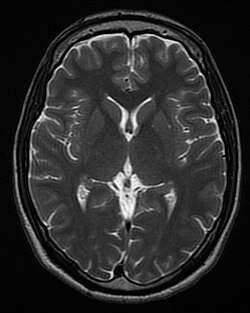
Notebook-first work can be the most honest form of a machine-learning study
The Alzheimer MRI repository is a useful example because the source artifact is not a polished training library. It is a Colab notebook that preserves the actual order of the work: loading data, inspecting images, building a TensorFlow pipeline, training a CNN, and comparing later variants.
That does not make the work less serious. It makes the chain of decisions easier to inspect.
Polish is not the same thing as fidelity
A cleaner interface is not always a better record of the work.
There is a common habit in technical presentation to treat notebooks as provisional artifacts and packaged code as the only serious final form. In research work, that distinction can be misleading. A notebook often preserves the actual order in which the work happened: data loading, visual inspection, preprocessing, model definition, training, evaluation, and the first attempts at comparison.
That sequence matters because it keeps the experiment legible. In this repository, the reader can see the study moving from MRI input inspection to dataset partitioning, augmentation, TensorFlow model definition, and later comparison logic without needing to reconstruct the process from a cleaned-up abstraction. When that chain is rewritten too aggressively into a cleaner package, some of the most informative parts of the work disappear with it.
What the notebook actually contains
The repository README describes a fairly direct experimental sequence, and that sequence is exactly what makes the artifact useful.
Load MRI data from Google Drive
The repository begins with data access and dataset construction rather than hiding those assumptions behind a packaged interface.
Build the TensorFlow pipeline
Resizing, rescaling, augmentation, and train-validation-test partitioning are visible parts of the workflow.
Train a baseline CNN
The initial model establishes the study's first pass at four-class staging rather than jumping immediately to more elaborate claims.
Evaluate held-out predictions
The project shows how the model is judged, which matters as much as the architecture itself.
Compare against ensemble variants
Later comparison becomes meaningful because it grows out of an already visible baseline rather than replacing it.
The input images remain part of the argument
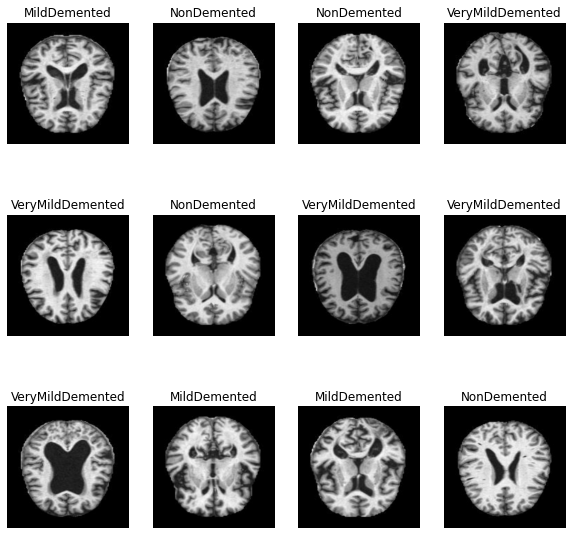
Representative MRI samples are useful here not as decoration but as a reminder that preprocessing and modeling decisions should stay proportionate to the structure of the data itself.
MRI sample montage drawn from the notebook output.
The notebook stays informative for four different reasons
Its value is not only that it runs. It also preserves the parts of the experiment that are easiest to lose in retrospective cleanup.
The classification target is explicit
The study distinguishes four disease stages rather than collapsing the task into a simpler binary distinction.
The workflow remains inspectable
Experimentation, preprocessing, training, and evaluation all live in one visible document.
The stack fits the stated goal
Google Colab, TensorFlow, and Keras are used in a way that suits exploratory model-building rather than pretending to be a production deployment.
Later comparison has a visible baseline
Ensemble extensions can be judged against the earlier CNN workflow because the intermediate steps are not hidden.
What the artifact supports, and what it does not
This is not a clinical product, and it should not be presented as one.
What the repository does well is preserve the experimental sequence with enough clarity to make technical judgment possible. A reader can see what data is loaded, how the TensorFlow pipeline is assembled, how the convolutional baseline is trained, and where comparison-oriented extensions enter the study. That is real value for anyone trying to understand the work as work rather than as a polished retrospective.
What it does not do is provide the stronger guarantees that would come from a broader benchmark, a more formal evaluation protocol, or a production-grade training package. In that sense, the notebook is valuable precisely because it does not disguise its scope. In scientific and medical machine learning, that kind of candor matters. A faithful experiment log can be more useful than a cleaner facade if the facade hides how the result was actually produced.