Refract system architecture record
A supporting architecture view of the Refract implementation across the frontend, backend, database, vector store, and file storage layers.
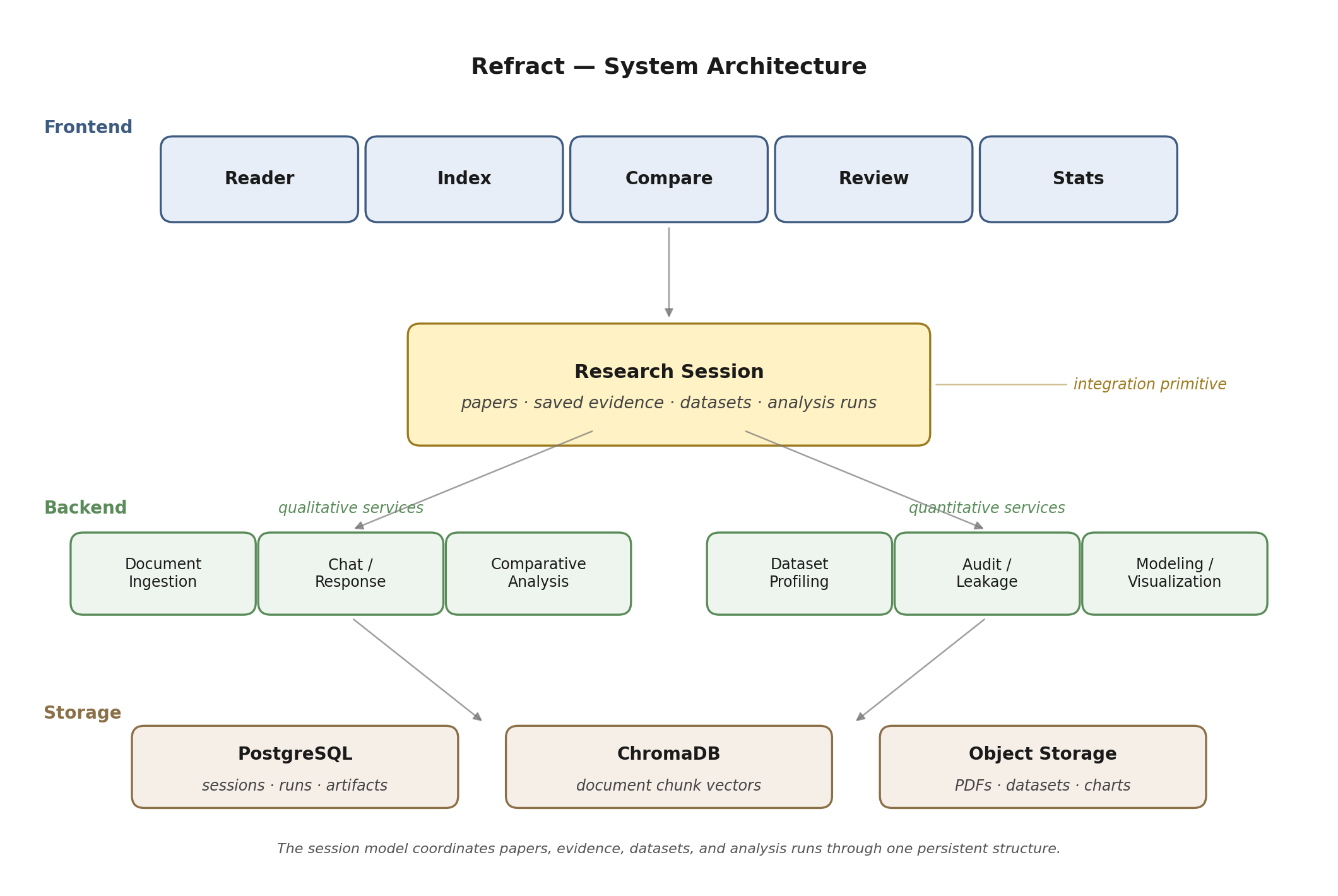
A technical view of the application boundaries
This diagram exists to make the system legible at the service and storage level. It shows how application state, uploaded documents, retrieval, and analysis outputs are separated without breaking the continuity of the session model.
The preview image is enough for visual reference, so the accompanying text stays focused on interpretation rather than repeating the diagram.
The architecture answers four practical questions
The point of the record is less about naming components than about explaining how responsibilities are divided.
Where does the research interaction happen?
The frontend holds the surfaces where reading, evidence capture, comparison, and analysis are actually used.
Where is application logic coordinated?
The backend handles the service layer that connects uploaded material, session state, and later analytical operations.
What kinds of state need to survive?
Relational state, stored files, and retrieval-specific context all have to remain available across the life of the session.
What keeps the parts from drifting apart?
The shared research session is the seam that allows these layers to stay coordinated instead of becoming separate tools.