Notes from a battery RUL project
In battery remaining-useful-life work, a strong score only matters if the feature story, time structure, and evaluation protocol remain believable under scrutiny.
A strong RUL score deserves suspicion before celebration
This note is preserved as a methodological reflection on what deserves scrutiny in a remaining-useful-life pipeline, especially when a result looks unusually strong.
The central concern is credibility: whether the path to a strong metric still makes sense once leakage, feature provenance, and evaluation design are examined closely.
Why RUL work is easy to flatter accidentally
Battery degradation data can contain strong structure even before the model does anything interesting.
In remaining-useful-life prediction, a very high score can be impressive or misleading, sometimes both. The first question worth asking is not whether the model performed well in a narrow numerical sense, but whether the path to that performance reflects a credible understanding of the problem.
Battery data has unusually strong built-in structure: capacity fades gradually, internal resistance shifts over long horizons, and many derived variables echo the same underlying degradation process. That makes the field attractive for modeling, but it also makes it easy to overstate what a model has learned. If the split leaks later-cycle information backward, if smoothed variables erase the local behavior that matters operationally, or if the features only make sense after offline preprocessing, the result may look excellent while still failing the real deployment question.
A battery score sits on top of several overlapping failure pathways
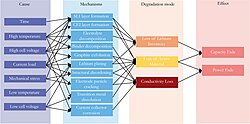
Even a compact diagram of lithium-ion degradation is enough to show why simple performance claims deserve inspection. Capacity loss, power loss, and mechanism-level changes interact over time rather than reducing cleanly to one variable.
Degradation-pathway overview from Wikimedia Commons.
The problem can be decomposed into a few hard questions
These are the checks I would want to pass before taking a result seriously.
Does the split respect degradation over time?
If the train-test split ignores sequence, the model may receive information that would never be available when the prediction is actually needed.
Do the predictors have a believable origin?
A variable can be highly predictive and still be unusable if it smuggles future information or depends on preprocessing unavailable in deployment.
Does the score answer the right operational question?
A metric only becomes meaningful once it is tied to the split strategy, baseline, and actual prediction task.
Can the model's performance be explained coherently?
A result is more convincing when the story behind the predictors still fits the physical system being modeled.
Feature honesty is as important as algorithm choice
The less glamorous part of the work is often the more decisive one.
A feature can be predictive and still be misleading. If it encodes future information, smuggles target structure through preprocessing, or only makes sense inside the training slice, then its apparent usefulness does not translate into a trustworthy model.
The practical work in projects like this is often less glamorous than model selection. It involves checking what each feature really means, how it would be available in deployment, and whether the resulting explanation of performance lines up with the physical system under study. In battery work, that means asking whether the predictor captures a signal a monitoring system could actually observe in time, whether smoothing has hidden the events that carry warning value, and whether the train-test split respects the chronology of degradation rather than merely distributing examples evenly.
Trust comes from the audit trail
A less dramatic but defensible result is usually worth more than a score that cannot survive questioning.
The most useful outcome of a strong RUL project is not a headline metric in isolation. It is a result that remains defensible after the data handling, feature design, and evaluation logic have been examined. The score should be explainable in terms of what the signals represent, when they become available, and how the model would be used by someone making maintenance decisions.
That kind of result usually looks less magical and more credible, which is exactly what good engineering work should produce. If the strongest claim survives a careful audit of chronology, feature provenance, and operational meaning, then the number has earned some trust. If it does not, the right response is not celebration but revision.